
Search
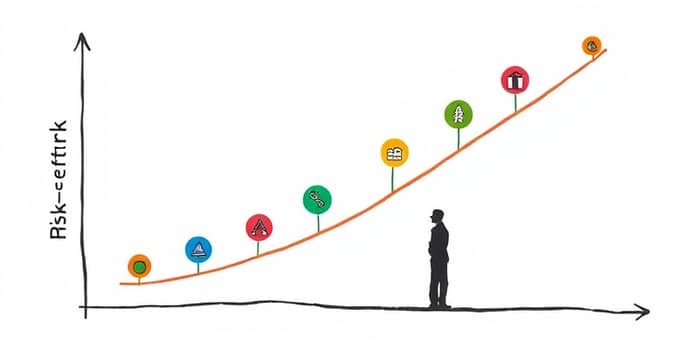
Investing often feels like walking a tightrope between ambition and caution. The efficient frontier guides you toward making choices that blend creativity and discipline to pursue your goals.
The efficient frontier represents the highest expected return for each given level of risk. Plotted as a curved line on a risk–return chart, it forms the upper boundary of feasible portfolios. Any portfolio resting on that boundary is deemed “efficient,” meaning no other combination of assets can deliver higher return at the same risk or lower risk at the same return.
Portfolios lying below the frontier are suboptimal. You could boost your returns without taking on more risk, or trim your risk without sacrificing yield. Conversely, points above the curve remain theoretical—
In 1952, Harry Markowitz revolutionized investing by introducing Modern Portfolio Theory. He demonstrated that investors must consider not only individual asset returns and volatilities but also how assets move in relation to one another. This insight gave birth to the concept of diversification: a mix of imperfectly correlated assets can reduce portfolio volatility without sacrificing returns.
Markowitz’s framework relies on three statistics: mean returns, standard deviation of returns, and correlations. By synthesizing these inputs, we build portfolios that align with each investor’s unique risk appetite.
Imagine a scatter of points on a graph where the x-axis measures risk (standard deviation) and the y-axis shows expected return. Each point represents a unique mix of assets. The cloud of points reveals the universe of possible portfolios.
The efficient frontier traces the best risk–return trade-off. Starting at the lower left—conservative mixes heavy on bonds and cash—you travel upward and right, embracing equities and higher-volatility assets. The curve’s concave shape illustrates diminishing marginal rewards: initial risk increments yield significant return boosts, but higher-risk increments deliver progressively smaller gains.
Constructing the efficient frontier involves several key steps:
Plotting these outcomes reveals which combinations rest on the frontier, unlocking a spectrum of efficient choices.
Mathematically, an efficient portfolio minimizes variance for a given target return. In formula form:
E[Rp] = Σ wi μi expresses expected return as the sum of each asset’s weight times its return. Portfolio variance is σp² = wᵀ Σ w, where Σ denotes the covariance matrix. By solving this optimization problem across multiple target returns, we trace out the complete efficient frontier.
When a risk-free asset (e.g., Treasury bills) enters the mix, an even more powerful concept emerges: the Capital Market Line (CML). By combining the risk-free asset with the tangency portfolio on the frontier, we form a straight line starting at the risk-free rate and touching the efficient frontier at the portfolio with the maximum Sharpe ratio.
Conservative investors lean toward the risk-free end of the CML, while aggressive ones can borrow at the risk-free rate to amplify returns. This framework unites all investors under a single optimal choice, differentiated only by their personal risk tolerance.
Understanding the efficient frontier isn’t just academic—it empowers you to:
Begin by gathering historical return data for your chosen assets and estimating correlations. Use off-the-shelf tools or financial software to run mean–variance optimizations. Examine the generated frontier and identify a portfolio that sits comfortably within your risk tolerance. Then, rebalance periodically to stay on track as markets shift.
The efficient frontier offers a compass and a map. It illuminates where you stand and shows the path to more efficient outcomes. By embracing this framework, you move from guesswork to a disciplined decision-making process rooted in quantitative rigor.
Whether you’re a do-it-yourself investor or partnering with an advisor, the efficient frontier equips you to navigate uncertainty with confidence. Let it inspire you to craft portfolios that truly reflect your goals and risk appetite, turning ambition into actionable strategies and dreams into measurable progress.
References