
Search
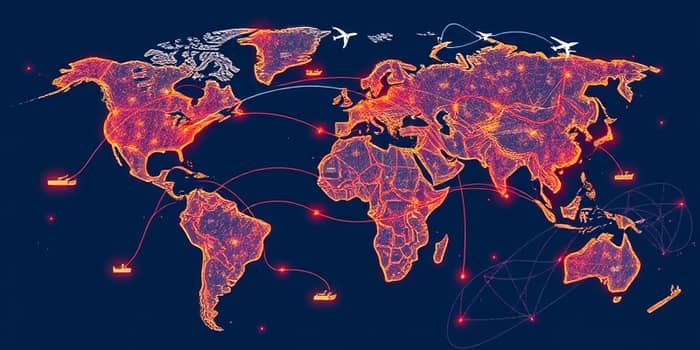
As we enter 2026, global commerce stands at a pivotal juncture. After record trade levels in 2025, businesses, policymakers, and communities face an environment defined by complexity, opportunity, and risk. Navigating these shifting tides demands insight, resilience, and concerted action.
Global merchandise and services trade surpassed $35 trillion in 2025, up roughly 7 percent year-on-year. Looking ahead, growth is expected to moderate amid tighter fiscal spaces, slowing GDP expansion, and lingering geopolitical fragmentation. The United States is projected to grow at 1.5 percent in 2026, China at 4.6 percent, and Europe offers modest demand supported by limited fiscal stimulus.
This slowing backdrop contrasts with the longer-term surge in cross-border exchange. In the decades following World War II, trade volumes expanded about 1.5x faster than global GDP, peaking near 60 percent of GDP by 2019. Since the 2008 financial crisis, however, that momentum has waned, making every percentage point of trade growth even more critical to livelihoods, investment, and innovation.
Yet despite tariffs, pandemic shocks, and supply chain disruptions, trade has remained remarkably resilient amid multifaceted shocks. New agreements among emerging economies, private sector adaptation, and reconfigured value chains have prevented wholesale deglobalization, providing hope that collaborative solutions can overcome current headwinds.
Governments have increasingly turned to tariffs and trade restrictions as tools of strategy and security. In 2025 alone, average global tariffs rose unevenly across sectors, driven by U.S. measures targeting advanced manufacturing and geopolitical objectives. Meanwhile, over 2,500 new restrictions were imposed within the first ten months of the year—nearly five times the level of 2015.
This environment puts pressure on the World Trade Organization’s multilateral framework and magnifies uncertainty for businesses of all sizes. To thrive, firms must build agile strategies that anticipate shifting rules and leverage emerging trade agreements.
Economic policy is no longer solely about markets and comparative advantage; it is deeply intertwined with national security. Heightened U.S.–China tensions have fueled strategic decoupling, export controls on semiconductors, and supplier diversification and nearshoring trends. Companies are relocating operations to politically aligned or lower-risk jurisdictions, a phenomenon often called "friendshoring."
Integrating political, commercial, and regulatory risk into holistic management frameworks has never been more critical. Leaders should adopt scenario planning, strengthen contingency networks, and engage with local stakeholders to secure continuity and reputational capital.
Today, nearly two-thirds of trade flows through global value chains (GVCs). Once driven primarily by cost optimization, these networks are now realigning around resilience, policy incentives, and sustainability. Climate targets, industrial subsidies, and digital transformation spur firms to redesign their footprints.
Organizations can strengthen GVC resilience by mapping end-to-end exposures, investing in alternative sources, and partnering across public and private sectors to develop robust regional clusters. Emphasizing agile manufacturing and digital coordination platforms fosters adaptability.
Goods still dominate headlines, but services now account for roughly 27 percent of global trade. In 2025, services exports grew around 9 percent, outpacing goods by a wide margin. These include IT, R&D, design, logistics, and financial services—inputs that underpin nearly 71 percent of manufacturing value chains.
Simultaneously, digital trade negotiations focus on cross-border data flows, localization restrictions, and e-commerce provisions. Firms that embrace digital platforms can unlock new markets, optimize operations, and reduce transaction costs, making data governance a strategic imperative.
Finally, environmental and climate-related trade is ascending. Carbon border adjustments, sustainable certification schemes, and investment in green technologies create both regulatory challenges and first-mover advantages. Businesses should embed environmental criteria into procurement, partner on renewable energy projects, and anticipate evolving green standards.
In this era of accelerated complexity and opportunity, resilience and collaboration are paramount. Firms that diversify suppliers, integrate risk management, and harness digital and green innovations will shape the future of trade. Policymakers must champion transparent rules, multilateral engagement, and inclusive partnerships to ensure that global commerce continues to drive prosperity for nations and communities alike.
References